


World Tuberculosis Day
Syllabus: GS2/Health
Context
- World Tuberculosis Day is celebrated on March 24 to educate people about tuberculosis.
About
- The day is observed to commemorate the anniversary of Dr. Robert Koch’s discovery of the TB bacteria in 1882.
- The theme for 2026 is “Yes! We can end TB”, which focuses on hope as well as action.
What is Tuberculosis?
- Tuberculosis (TB) is an infectious disease that most often affects the lungs and is caused by the bacteria Mycobacterium tuberculosis.
- It spreads through the air when infected people cough, sneeze or spit.
- Symptoms: prolonged cough (sometimes with blood), chest pain, weakness, fatigue, weight loss, fever, night sweats.
- While TB usually affects the lungs, it also affects the kidneys, brain, spine and skin.
- Treatment: It is preventable and curable with antibiotics.
- TB Vaccine: The Bacillus Calmette-Guérin (BCG) vaccine remains the only licensed vaccine against TB; it provides moderate protection against severe forms of TB (TB meningitis) in infants and young children.
India’s TB burden and progress
- TB as a global health challenge: India has the highest TB burden in the world, contributing to 26% of the global burden and 29% of global TB-related deaths.
- India is followed by Indonesia (10%), China (6.8%), the Philippines (6.8%), and Pakistan (6.3%).
- Multidrug-Resistant TB: India represents 27% of the world’s multi-drug-resistant TB cases, underscoring the need for specialized treatment approaches.
- The World Health Organization (WHO) has recognised India’s progress, with a 17.7% decline in TB incidence from 2015 to 2023, a rate more than double the global decline of 8.3%.
- India aims to eliminate TB through programmes like the National TB Elimination Programme.
Source: AIR
National Biodiversity Authority Constitutes Expert Committee on Invasive Alien Species
Syllabus: GS3/Environment
Context
- The National Biodiversity Authority (NBA) has constituted an Expert Committee on Invasive Alien Species to address the growing ecological and socio-economic risks posed by such species across the country.
About
- The decision follows a suo motu proceeding by the National Green Tribunal, which underscored the serious threats of invasive alien species to native biodiversity.
- The Committee has been mandated to prepare a consolidated national list of invasive alien species based on State-wise inputs.
- The Committee will identify and prioritise high-risk species and recommend science-based management strategies, ecological restoration measures, and national-level guidelines for their prevention, control, and eradication.
- The Committee will function for a period of two years and will contribute in safeguarding the country’s biodiversity.
National Biodiversity Authority (NBA)
- The National Biodiversity Authority (NBA) was established in 2003.
- It is a statutory body that performs a facilitative, regulatory and advisory function for the Government on the issue of Conservation, sustainable use of biological resources and fair equitable sharing of benefits of use.
Source: AIR
SEBI Revamps Framework on Conflict of Interest
Syllabus: GS3/ Economy
Context
- The Securities and Exchange Board of India (SEBI) has approved major reforms to strengthen ethical governance and improve ease of doing business in capital markets.
Background
- SEBI faced scrutiny after allegations by Hindenburg Research regarding conflict of interest involving former SEBI Chairperson Madhabi Puri Buch.
- In response, SEBI constituted a High-Level Committee (HLC) in March 2025 to review its conflict-of-interest framework.
Key Reforms Measures
- Uniform Restrictions on Investments: All SEBI employees, including the Chairman and Whole-Time Members (WTMs), are prohibited from trading in equity and equity-related instruments.
- Only investments through mutual funds are permitted.
- New investments are allowed only in pooled instruments managed by regulated intermediaries.
- Mandatory Disclosure and Divestment: Senior officials must either liquidate or freeze their holdings in equity instruments and commercial ventures, including unlisted companies.
- These restrictions are extended to family members (with limited exceptions).
- Insider Trading Norms: Senior officials, including the Chairman and WTMs, are now explicitly classified as “insiders.” This ensures stricter compliance with insider trading regulations.
- Asset Disclosure Requirements: Senior officials must publicly disclose immovable assets, similar to Union civil servants.
Source: IE
Modifies of Credit Guarantee Scheme to Support MSME Manufacturers and Exporters
Syllabus: GS3/ Economy
Context
- The Government has modified the Mutual Credit Guarantee Scheme to support Micro, Small and Medium Enterprises in line with the Budget 2025-26.
Mutual Credit Guarantee Scheme for MSMEs
- Mutual Credit Guarantee Scheme for MSMEs (MCGS- MSME) was launched in 2025.
- The scheme provides 60% guarantee coverage by National Credit Guarantee Trustee Company Limited (NCGTC) to Member Lending Institutions (MLIs) for credit facility up to ₹ 100 crore sanctioned to eligible MSMEs under MCGS-MSME for purchase of equipment/ machinery.
Modifications in the existing “MCGS–MSME” scheme
- Upfront Contribution: 5% Upfront contribution made refundable, 1% each from 4th year onwards, subject to satisfactory performance of loan account.
- Eligibility: Service Sector MSMEs also included in the Scheme.
- Minimum project cost towards Machinery / Equipment: Cost of equipment/ machinery reduced up to 60% of project cost from earlier 75%.
- Guarantee Tenure: The credit guarantee would expire after 10 years, as compared to the unspecified period in the earlier scheme.
Incorporation of Special Provisions for Exporters
- Eligible exporters: Profitable units having exported at least 25% of their sales turnover in each of previous 3 financial years and satisfying certain export realisation conditions.
- Guaranteed Loan Amount: ₹20 crore.
- Guaranteed Loan Amount: ₹20 crore.
- Upfront Contribution: 2% of loan amount (Max ₹40 Lacs); 1% each refundable in 4th and 5th year of the guarantee period.
- Guarantee Coverage: 75% of the amount in default.
Source: PIB
Minor Planet Centre (MPC)
Syllabus: GS3/Space
In News
- The Minor Planet Center (MPC) has recently announced the discovery of 15 new moons (natural satellites)—four around Jupiter and eleven around Saturn.
About Minor Planet Centre (MPC)
- The MPC is the global repository (central database) for observations of small bodies in the solar system (asteroids, comets, and minor planets).
- It operates under the International Astronomical Union (IAU) at the Smithsonian Astrophysical Observatory, Cambridge, Massachusetts, USA.
- It plays a key role in tracking, cataloguing, and identifying celestial objects beyond major planets.
Functions of MPC
- Data Management: Receives and verifies astronomical observations to calculate orbital paths and assign official scientific identities to new space objects.
- Tracking NEOs: Monitors Near-Earth Objects (asteroids/comets) and collaborates with NASA to assess potential collision threats to Earth.
- Global Coordination: Publishes scientific updates to inform researchers of new discoveries, enabling worldwide collaboration among observatories for further study.
Source: TH
Diego Garcia
Syllabus: GS1/Places In News
In News
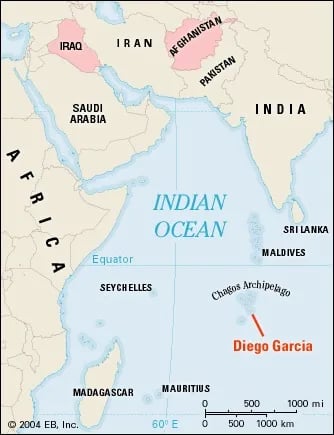
- Reports have indicated that Iran attempted a missile strike on the Diego Garcia base.
About Diego Garcia
- Located in the Chagos Archipelago (British Indian Ocean Territory), Diego Garcia is a strategic island base in the Indian Ocean. It is a joint US–UK military facility.
- It serves as a key logistics and bomber base (launch point for long-range military operations) in West Asia.
- Its distance from Iran is about 3,800–4,100 km. It was previously considered beyond Iran’s strike capability.
Previous article
Empowering Women Farmers in Agriculture
Next article
The Judicial Push for Environmental CSR
